https:///uklgbt-8351019afa-ghaeg7hvg4fma3a8.a03.azurefd.net/feed/" rel="self" type="application/rss+xml" /> uklgbt-8351019afa-ghaeg7hvg4fma3a8.a03.azurefd.net
There’s no official statistics on this but I strongly suspect that almost all LGBTQ+ officers and staff, will have been a victim of hate whether in their personal life or as they make an arrest, manage a call for service or process a detainee. And its important people know this. They need to know that policing really understands the impact these crimes have and how hard it can be to speak out – because it is and I should know.
Like most LGBTQ+ people in policing reading this, I too have been a victim of homophobic hate. Even now, many years later, it’s still really hard to deal with. Hate can take many forms and can range massively in severity, but even the seemingly minor can have a lasting effect. They eat away at our self-esteem as offenders target the heart of our self-identity. And that personal impact matters.
Of course, LGBTQ+ people aren’t unique in this. People who are disabled, who hold faith-based beliefs and who are black, Asian or who are from another minority ethnic groups will have suffered too. But I’m focussing on LGBTQ-related hate as 17 May marks International Day Against Homophobia, Biphobia and Transphobia (IDAHBT). That and I’m the national lead for LGBTQ+ issues in policing.
Some people may think that hate crimes aren’t real crimes, that it’s just ‘woke’ nonsense. But they are real crimes and we’ve focused on them for many years now. They have a real impact and deserve our time to investigate on a scale proportionate to the offence.
IDAHBT highlights how – in the 21st century – LGBTQ+ people are still being targeted because of who they are and who they love. That’s not OK.
LGBTQ+ people are a reality. We exist and we deserve to be able to live our lives, just like everyone else. This isn’t’ special treatment’ – it’s the law! But how do we get people – including colleagues – to report hate crimes?
I know that reporting homo, bi or trans-phobic hate crime can be hard, especially if you’re not out. Fortunately, policing is used to this and we have a legal responsibility to keep personal information safe. There’s also lots of organisations including staff networks, who can support you every step of the way and who can explain your options. Those options can include the punishment the offender receives which can range from letters of apology and other restorative justice approaches, to lengthy jail terms for major crimes.
The charity Galop is a national policing partner. They provide helpline services for LGBTQ+ victims and survivors of abuse and violence. Their research shows that three in five LGBTQ+ people have experienced a hate crime.
Like other crimes concerning vulnerability, it’s really important that victims have someone else to turn to other than the police to report incident and get specialist support. That’s because growing global research shows that lots of minority groups – including LGBTQ+ people – have lower levels of trust and confidence in policing than people from majority groups. There’s lots of reasons for that and raising the LGBTQ+ community’s trust and confidence in policing one of my long term aims.
So remember, hate crimes are real crimes. They matter to you and they matter to policing. Please report them and encourage others to do so too.
Deputy Chief Constable Vanessa Jardine is the National Police Chief Council lead for LGBTQ+.
You can find out more about Vanessa in her profile here.
]]>Former Co-Chair of the National LGBT+ Police Network, Tracy O’Hara has been recognised with a lifetime achievement award from Liverpool Pride. Tracy is the Co-Chair of the Merseyside Police LGBT+ Network, taking on the role in 2003 where they’ve been campaigning for LGBT+ equality and inclusion on a local, national and international level from before then to today.
Tracy joined Merseyside Police in 1996 “to be Christine Cagney” and had early aspirations to be a Detective. She worked in the City Centre for the first 5 years in a job that she loved, but an environment that she hated; one filled with homophobia, fear and secrecy. Tracy was not out and after 5 years was planning to leave Merseyside Police. Fortunately, a friend pointed her towards the Gay and Lesbian Support Network (as it was known at the time). For the first time in her career, Tracy saw people like her, but also people who were striving to change the Police into an organisation that respected difference, and she jumped right in.
Tracy has led the Network through a range of challenging and engaging moments, including the murder of Michael Causer in 2008, achieving 8th place in the Stonewall Workplace Equality Index in 2009, getting Merseyside Police to allow officers to march in uniform at Liverpool Pride in 2011 and convincing the organisation to have a ‘Police with Pride’ car within their operational fleet.
Tracy became chair of the newly formed National LGBT+ Police Network in 2015, remaining in role until 2020. She has been named Police Officer of the Year, International Police Officer of the Year and was awarded a Queens Policing Medal for distinguished services to policing in 2017. She has also received what can only be described as the ultimate award for a commitment to diversity when she was namechecked in an article in the Daily Mail in 2009.
Tracy’s Key Achievements
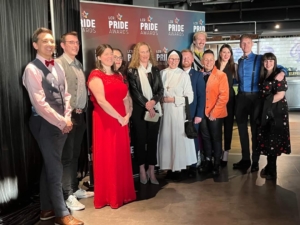
Red Umbrella
Red Umbrella was a partnership between Merseyside Police and The Armistead Centre focussing on supporting and engaging with sex workers across Merseyside. Merseyside Police treats all crimes against sex workers as hate crimes, and Tracy was the lead police officer for the project which ran for four years, building links with the community and earning the trust of people who fear the Police and do not report crimes against them due to concerns about how they will be treated.
Liverpool Pride
Tracy led the LGBT+ Network during its negotiations with Merseyside Police about being able to march at Liverpool Pride. For the first year, staff were not allowed to march in uniform and had a contingent of 8 people in Police With Pride polo shirts. Fast forward a few years and over 100 officers, staff and volunteers including the Chief Constable joined Merseyside Police to march through the streets of Liverpool.
Setting the National Agenda
During her time as chair of the LGBT+ Network, Tracy convinced then Assistant Chief Constable Julie Cooke to take on the portfolio lead for LGBT+ equality in the (now) National Police Chief’s Council. A strong, positive working relationship led to trans guidance for the policing sector bring published, including on supporting trans staff at work, the rights of trans staff when searching and recommendations on uniform and internal records.
Untold: The Police
In 2021, Tracy participated in a national advertising campaign, where the Home Office partnered with Channel 4 to record three short interviews where young people interviewed a police officer to gain insight into what their role is like today. Tracy was spoken to about the need to create a more diverse and representative police force.
Flying the Rainbow Flag
Merseyside Police flew the rainbow flag at its Headquarters building in Liverpool City Centre for the first time to mark the International Day Against Homophobia, Biphobia and Transphobia in 2008. The decision itself was relatively simple at the time, however Merseyside Police were hit with a number of freedom of information requests demanding to know why this was authorised and what planning permission had been authorised to allow this. Chief Officers joked about having to become flag etiquette experts, however through both Tracy’s perseverance and a supportive chief officer team, Merseyside Police continued to fly the rainbow flag year on year, and respond to the freedom of information requests, year on year.
You can read more about Tracy in her role as European Representative for the National LGBT+ Police Network here.
]]>The report around accounts of homophobic behaviours is uncomfortable and hugely upsetting to read.
And rightly so.
As a Network, we exist to empower and support our staff to deliver the best possible service to victims and communities through having LGBT+ inclusive Police forces. Policing is more LGBT+ inclusive than we have ever been, but as the Casey report documents there is still homophobic discrimination and bias, which leads to negative experiences of colleagues, victims and communities.
Now is the time for fundamental change and as a Network we will work with Police forces and Stakeholders to provide the Policing service that the public deserve, a service they can trust and a service that treats them with dignity and respect. There can be no place in policing for homophobia, biphobia or transphobia, and we are actively making policing a place that is anti discrimination of any kind.
]]>
MAN MADE
As someone who identifies as a non-binary, trans butch person – I had to wait a while before I saw a representation of someone else like me on screen. Until the age of 47 to be precise. On another continent too, as the film of which I am speaking, MAN MADE, was only shown in selected cinemas in the United States during in 2019. I was lucky as 1) my twin’s wife had seen a promotion of the film on social media, 2) it was going to be showing in their home town of Athens, Georgia, and 3) I was on holiday visiting on them in the US when it was being shown.

The film is about an all-trans bodybuilding competition held in Atlanta, Georgia. It follows the physical and emotional journey of four trans guys as they prepare for the competition. Spoiler alert: the moral of the film is that all the competitors are winners for having the courage to get up on stage and be proud of who they are.
The film is a rarity on several fronts, because it’s:
- Got a feel good, positive vibe and happy ending
- About trans men
(The only other one I know about a trans guy is the 2002 film Boys Don’t Cry, which depicts the 1993 murder in Nebraska of Brandon Teena aged 21, certainly not what you’d describe as on screen inspiration …)
- Directed by a trans guy too – delivering on the creed of ‘nothing about us without us’
- Focused on something other than the surgical transformation of transition
As one of those who feature in the film, Mason Caminiti, said here:
Bodybuilding empowered me to take control over my life by transforming my body in ways that I couldn’t fathom. It also made me realize that what I do and who I am has real, measurable, physical, and mental results. Most importantly, my success matters not only to me, but to others. I let nothing stop me, including the opinion of naysayers and the self-doubt that lingered most of my life. I realized that I count and belong to something greater than myself. I’ve lifted weights as if my life depended on it because indeed, it has.
Bodybuilding offers a ready metaphor for personal transformation, showing how exhibiting one’s strength after years of privately embodied pain, can be freeing – even euphoric.
Having grown up during Section 28, I only fully understood my identity at the age of 35 after chatting with a guy in my gym who was generous enough to disclose he was trans. I can’t say if I’d have seen MAN MADE when I was growing up if I would have transitioned sooner. What I can say, is the film showed me I’m not alone – I’ve finally found my tribe.
For others, I hope the film offers inspiration as to how it’s possible to take control of your body to reduce dysphoria while waiting for medical support. It portrays the many different trans masculine bodies with their different starting points and journeys. Finally, rather than finding your body an everlasting source of shame – it teaches you how to love your body, to take pride in it and to fully embrace its potential.
Written by PC Al Smith of West Midlands Police. Al is the Trans Lead for the National LGBT+ Police Network and you can find out more about Al here.
]]> It’s now over 28 years since I became a police officer. Never in a million years did little old me dream that one day I’d become one of the most senior women in British policing. It just wasn’t part of the plan.
If the truth be told, I was never that ambitious. I always just wanted to be a good cop and to help people. That meant always trying to be the best I could be, making the most of every opportunity and learning some lessons along the way.
After leaving university, I wanted to do something with purpose. So, I joined Greater Manchester Police at 24-years-old. Now here I am in the process of packing up my life for a new adventure.
Growing up, there were three women in my life who really got me to think about a career in policing. I’ll never forget their names: Christine Cagney, Mary-Beth Lacey and Jane Tennison (I bet you were thinking I was going to say something much more profound)!
Cagney and Lacey served with the NYPD in the 1980s. Every week I’d tune in to watch them lock up some of the city’s most dangerous. Meanwhile in 90s Britain, DCI Tennison was smashing through policing’s glass ceiling and leading teams to round up serial killers and more.
I’m sharing this with you as we mark LGBTQ+ History Month. Fittingly, this year’s theme is Behind the Lens. It’s about recognising the contribution LGBTQ+ people have made to cinema.
Cagney and Lacey, and Prime Suspect were both massively popular shows and I’m sure policing has them to thank for drawing in hundreds of new recruits.
They were my onscreen inspiration. As straight women, Mary-Beth, Christine and Jane may not have told me who I was, but they told me who I wanted to be – a cop with pride, integrity and guts.
I’ll leave it for others I’ve served alongside to decide if I have integrity and guts, but I know that I am proud. I’m proud to have worked with some brilliant people at GMP and West Midlands Police, I’ll be proud to head-up Northumbria Police and I’m proud to lead on LGBTQ+ issues for the National Police Chief’s Council.
Much like being a Man City fan, policing is a tough and often thankless job. In some ways, that’s what makes it the best career in the world. We do what we do because we know this work matters. There’s nothing like it.
This LGBTQ+ History Month, I’d ask you to think about who your inspiration in life was. How do you measure up to them now?
I’d also ask you to think about who you’re inspiring with your words, actions and attitudes? Would you be the person your younger self needed during past tough times? Would you make little you proud?
It’s never too late for a fresh start. I know I’m looking forward to mine in the north east. And who knows, I may even binge watch some Christine, Mary-Beth and Jane for some inspiration (although I’m not sure big hair and constantly sliding over the bonnet of my car could ever be described as professional conduct).
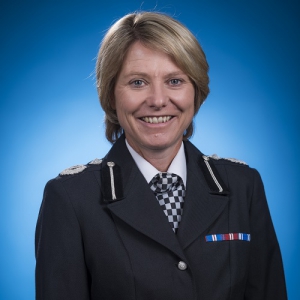
Deputy Chief Constable Vanessa Jardine is the National Police Chief Council lead for LGBTQ+.
You can find out more about Vanessa in her profile here.
]]>Sex Education

Sex Education is a TV series on Netflix which follows the lives of fictional Sixth Form age students as they navigate through new experiences, experimentations and dilemmas related to sexual intimacy. The growth, inclusivity and relatability of these coming-of-age moments are rarely seen on screen and may be regarded as ‘taboo’, but, they are representative of journeys that many people go through in their lives.
There is one particular moment of this show which stuck out to me. In Series 2, Episode 4, Florence, who is a side character in the show, speaks about her lack of desire to have sex. She expresses how pressured she feels to conform and how she feels “like a freak” for not wanting sexual intimacy. This is interpreted as her not being ready yet and she is told she will be ready once she finds “the right person”. Later in the show, Florence has a conversation with a Sex Therapist to try and ‘fix’ her issues, saying “I think I may be broken” and that when thinking of having intimate relationships she doesn’t “feel anything” and has “no connection to it”. What Florence doesn’t realise at this moment is that she is Asexual. Only through this conversation with a professional does she find out what Asexuality is and that it is something she identifies with.

This scene on Asexuality, and this accurate portrayal of an Asexual character, is the only time I have ever seen Asexuality on TV, in film, or in any kind of content I consume. Information and publicity of Asexuality is rare – the majority of people will have never heard of it and won’t know what it means. This means, much like Florence, Asexual people feel quite alone, even within the LGBTQ+ community. It also means that too often, when talking about their personal experience with sexuality, Asexual people are met with those same comments which were said to Florence in the show.
Scenes like this are so important. It is vital for underrepresented groups, like members of the whole Ace community, to see themselves represented on screen as it shows that they real and are not alone. Sex Education showed an Asexual character, in a delicate, accurate and relatable way to audiences of over 40 million people worldwide. 40 million people who will now have an opportunity to learn what asexuality is and what being ace means. More importantly, it will give an opportunity for those at home – who are having the same thoughts around sex and sexuality as Florence did – to see someone like them on screen. That’s why this scene mattered to me. It shows that Asexual people are not broken and do not need to be fixed. It also reinforces that Asexual people can have companionship, intimacy, and love without sex. And, that “sex doesn’t make us whole”.
If you haven’t seen Sex Education you’re missing out on one of the most entertaining and positive shows around. Sex Education can be seen on Netflix. Ace is used as an umbrella term for the asexual, aromantic and grey-sexual community. Tash wrote this, they can be found working as a policy assistant for West Midlands Police and Crime commissioner. You can reach Tash at natasha.cullen@westmidlands.police.uk.
]]>
Cagney and Lacey and Ellen
Growing up I never really thought too much about attraction as I was busy supporting Middlesbrough, playing hockey and some football (albeit when the dinner nannies weren’t looking). I began to notice a TV program that got me hooked due to there being female Detectives on there, a catchy soundtrack and characters with a bond that was all new to me. Cagney and Lacey were the people I wanted to be. I watched in awe as they slid down bannisters in their skirts, without dropping their handbags and keeping hold of their guns.
This inspired me towards being in the Police. With my attractions till not really forming part of life.
This was until I got to my early 20’s. By then I had gone to University and kissed a girl and I liked it.
So there we have it, a journey of personal discovery began. That was until I joined Merseyside Police in 1996. Playing the field was on TV and Ellen was on her way out of the proverbial closet. The environment I worked in was homophobic, isolating and yet, I loved (and still do) being a Police officer.
The star footballer on playing the field was a police officer. I went to work feeling illuminous as conversations unfolded about both the show and her. I stayed still and never uttered a word about my then girlfriend, nor life away from work.
 Ellen coming out was global news. She did it with aplomb, she was bold and then she lost work and kudos. I was just silent. I could not and would not speak my truth.
I was a thief taker, I was proactive and I was living my dream of being a police officer. Cagney and Lacey had paved the way.
However, I was aware of S28, I was not out nor open and Merseyside Police weren’t getting the best out of me. I watched the media with sadness and fear. George Michael outed, Freddie Mercury passing, Queer as folk hitting the screens and the pop scene being awash with Gay men. And yet I remained silent, I remained firmly in the closet.
It took a crossroads around 2001 when I thought do I stay, do I leave, what do I do?
That path took me to Debbie, my police trainer. She told me to stay, to change the organisation from within and she also guided me to the LGBT+ network. It was in its infancy, however for the first time, I found people a bit more like me. We met in secret, in the dark, with hoods up and brogues well hidden.
I have not looked back I have to say. The network gave me wings and around the same time, I got a CID attachment. I have been a Detective since 2001 and have loved every minute. I got to be a real life Christine Cagney (without the quiff) and to live my dream and my truth.
I am out and proud, I am thriving and enjoying every moment of my Police role. I am a Detective Sergeant, I have a Queens police medal for distinguished services to Police, I was Officer of the year in 2009 and International Police officer of the year followed on the same year.
I even got to go to USA and really feel like Cagney and Lacey, albeit it was more the drinking coffee and eating bagels than sliding down bannisters, that I got to do.
From seeing it, to being it and all because of a TV show with positive female Detective role models, to Ellen’s courage and that of many others since, I have achieved beyond my wildest dreams.
Don’t let anyone ever tell you that seeing imagery, TV representation, film characters, public figures who look a bit like you, isn’t important, it is.
Cagney and Lacey is available on a variety of streaming services. Ellen can be seen on Amazon Prime. When they’re not eating bagels and sliding down bannisters, Tracy can be found working hard to protect Merseyside’s most vulnerable people, you can reach her at Tracy.O’hara@merseyside.police.uk.
]]>
Holby City

My first memory of an LGBT+ character and storyline in a TV show I watched was on Holby City (and later Casualty) in 2002. I would have been fourteen at the time (so slightly too young to have seen Queer as Folk), at an all-boys Grammar School, and I remember being very drawn to the actor (David Paisley). This wouldn’t have been my first crush, but as it turns out, it was my first crush on someone who was actually gay (on screen and in real life as well). I’m pretty sure his character wasn’t openly gay when first introduced onto the show, but insinuations were made because he was a male midwife. He started a relationship with another character on Casualty who eventually killed him, I’m not sure happily ever after storylines were allowed for LGBT+ characters at the time, there the old trope that gay characters are often killed.
I would have mostly watched the show with my Mum and possibly my Dad if he was home – my older sisters would have been out of the house or away at university and my younger brother wasn’t interested in the medical programmes. At the time I was coming to terms with my own sexuality (I came out when I was fifteen). I knew I was gay, but I didn’t know what that was and what that meant. There were no LGBT+ role models that I knew of and the limit of my experience was being called gay in the playground, and that wasn’t a compliment!
I still remember that feeling when the two characters first kissed, a mix of awe and guilt, alongside the squeamishness of watching it with my parents. I don’t remember how my parents reacted, if they even did, but my eventual coming out was a bit of a shock to them. Reflecting back, this storyline gave me confidence that there were other gay people and pushed me to explore other programmes with LGBT+ storylines, such as Tipping the Velvet which was released the same year.
Just in case David gets to see this, I’ll add a personal message. This visibility on a mainstream TV programme had a real impact on me and gave me a role model when I had none. I’ve no idea whether you took on this role for that reason, or just because it was a job, but I’m really glad you did.
Holby City finished it’s run in March 2022, however Casualty is on BBC 1 every week and is part of the Holby City cinematic universe. David Paisley has campaigned for LGBTQIA+ rights and inclusion, he has played roles in River City, Tinsel Town and EastEnders to name a few. When Adam isn’t watching medical drama with his Mum, he works for Merseyside Police and can be reached on Adam.Hodgson@merseyside.police.uk
]]>
‘It’s a Sin’ – A review by Neil Hughes – West Midlands Police

‘It’s a Sin’ is a Channel 4 TV series that follows a group of gay men who move to London in 1981. They form a friendship group but the fast-developing HIV/AIDS crisis in the UK impacts upon their lives. Over five episodes the group are shown living through an entire decade until 1991.
The series begins with five 18-year-olds; Ritchie, Jill, Ash, Collin and Roscoe who come from different walks of life and move to London. They all meet and quickly form bonds moving into a flat together they name ‘The Pink Palace’.
In 1986 we see the flatmates all working, falling in love and finding their way in the world. Colin’s health takes a turn and he is diagnosed with AIDS, forcing the group to confront the reality of the situation.
1986 was the same year I joined West Midlands Police. I was from a working-class family, 21 years old, heterosexual and from the Black Country. I was posted in Birmingham City Centre which was like being dropped on Mars. Those early years for me were a struggle with bullying, racism and homophobia present in the Police Force.
‘It’s a Sin’ really touched me and resonated with the struggles the cast were having with their sexuality with the struggles I was experiencing in the Police at that time. Luckily there were some great young Probationers and an exceptional gay Sergeant called Roger who inspired me to keep going.
One of the things I am not proud of in my Police career was being tasked to target men in Public toilets for Importuning and Gross Indecency in 1988/89 (sometimes referred to as ‘cottaging’). Since the 1950’s Police had targeted gay and bi-sexual men in toilets. The men we caught were lonely, confused about their sexuality, some were gay, some were bi and some were questioning. One of my biggest regrets now in my Police career was not standing up and refusing to do it.
Even though ‘cottaging’ is still an offence under Section 71 Sexual Offences Act 2003, I still wanted to say sorry for targeting them and criminalising their actions.
1988 was the same year Section 28/Clause 28 was introduced by Margaret Thatcher’s Government that prohibited any positive discussion about homosexuality by local authorities. It remained in statute until 2003 in England and Wales.
I continued to strive to be the best I could in the Police Force and served for 30 years as both a Sergeant and a Temporary Inspector. I always tried to inspire others to battle against injustice and speak up if they were uncomfortable with what they were being asked to do. I am still proud to be part of the Police family today and am currently working with WMP as a support staff member and more importantly an LGBT+ Ally.
Policing has come a long way since 1986; they were the best of times but also for some the worst of times.
]]>
A beautiful thing.
When I was growing up in the late 90’s in Northern Ireland, being LGBT+ wasn’t something talked about in families or even positively at all, there was very little visibility and hardly any positive representations of LGBT+ people or families in mainstream media, EastEnders had their ‘first gay kiss’ but my Dad had banned EastEnders in our house, so I never got to see it. The only time I ever heard the word ‘gay’ used was as an insult in school. The only time I heard people talk about ‘homosexuals’ was the seemingly endless procession of society’s leaders queuing up to denounce and berate the community, calling us deviants and perverts. The newspapers were filled with hateful headlines such as, “Britain threatened by gay virus plague”, “My doomed son’s gay plague agony” and “AIDS is the wrath of God”. There was a moral panic that seemed to surround anything there was to do with queer people, at the time being gay was grounds to be sacked or refused employment, we couldn’t get married, the age of consent was unequal, everything about us was unequal. It was not ok to be gay. I knew I was gay, I felt different, acted different and I had fallen in love with another boy, albeit unrequited. I was so afraid and isolated at that time. There was no visible LGBT+ role models, no youth groups for us, no one like me I could turn to or talk to, at 15 years old it felt like I was the only person like me in Northern Ireland.
NI was changing at the time, it felt like change was constantly all around us, after decades of conflict, the prospect of real peace and societal change was on the horizon. For people of my generation born in the early 80’s, it finally felt like the future was full of possibilities, positive change and peace. Maybe there could be change for us queer people too, I hoped. Maybe we would be allowed to exist as equals, in the new society that was being created around us. The present looked bleak but hope for better existed.
In the midst of all this and what I was feeling I saw a group of LGBT+ activists appear time and time again in the papers my Dad read and in the news on TV. They were called Outrage and were led by Peter Tatchell. I was able to find a phone number for their London office using directory enquiries, (remember that?) the internet was around but it was difficult to access and information was so limited. I called Outrage from a phone box on the main road near my home, terrified what would happen if anyone knew who I was ringing. I got through to a very kind and well-spoken Scottish man called David Allison, I was shaking and crying talking to him, telling him that I was gay and terrified to tell anyone, he was the first person I had said those words out loud to. David talked to me till my 10p coins ran out then he called me back to the phone box so we could keep talking. We spoke many times since then for the best part of a year. He was my lifeline and support, a voice in the dark that told me I was ok to be me. David connected me with the LGBT+ community in Belfast and sent me a video tape (remember those?) in the post of a film he wanted me to see.
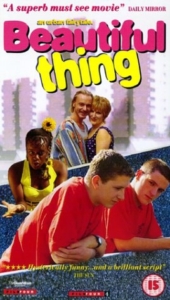 The film he sent me was called ‘Beautiful Thing’, I watched it in secret one night when my parents went out. It was a revelation to me. It was the first time I saw a story about people like me framed in any sort of positive light. The story is set in a working class estate in east London, it follows two teenage boys Jamie and Ste, who meet at school and fall in love, it tells the story of how they eventually find community and acceptance from one of the boy’s parents by the end of the film. The story is sweet, probably a bit tame and prosaic by today’s standards. There’s no dramatic twists, salacious moments or sensational elements, it’s just a simple story of two young men falling in love and the people around them. The characters around them are arguably more interesting that the two central characters, as it’s them that add the drama and tension to the story. The colourful characters surrounding the two boys show how ordinary the love between Jamie and Ste was. The film makes the case that Gay love was the same as any other love and it too could be a beautiful thing. This was the main message I took away from the film. This was in stark contrast to the messaging and moral panic around gay people at the time. That negativity had made me feel like a freak, who wasn’t worthy or capable of love. Seeing this representation, this nice wee story of two young men falling in love, shattered that negative perception which society had given me. Seeing this story, empowered me and let me know that love was meant for queer people too, that we weren’t all doomed to die alone, miserable & in agony. That our stories and our lives mattered. We have community, we have each other, we have love, just like everyone else. This seems obvious now but back then it wasn’t so apparent, nowadays the stories of the queer experience are all around us, nearly every show on TV has a queer character (or several). Shows like Queer as folk, Heart stopper and Sex education have empowered this current generation to be themselves. This is a good thing but it wasn’t always like this, seeing representation of queer people and our love in the 1980’s and 90’s was a rare thing. I’m glad it’s not anymore. I’m really glad our stories are out there for everyone to see.
Seeing ‘Beautiful Thing’, this piece of representation at such a pivotal and sensitive moment of my life and the support I got from David had a dramatic effect on me. I didn’t feel afraid of being alone anymore, because I knew I wasn’t. I was a part of something, I had community and in that community there was love. This is why representation matters, seeing ourselves reflected in the stories around us, lets us know that we are not alone, and that we are heard and understood. No one should grow up feeling isolated because they’re different, we as queer people need to keep telling our stories, so that those young people coming up now don’t feel the isolation and fear I did when I was a teenager. Our stories are part of building a better future for all of us and that is a beautiful thing.
I tried to reach out to David, to let him know I was writing this, to tell him how he had helped me accept who I was and the impact he had on me as a young man. Sadly I found out that he passed away just last year. This is a timely reminder that we don’t have all the time we think we have, if someone had a big impact on you or helped you at a difficult time. Tell them, let them know how much they mean to you and that you appreciate them, before that time runs out.
Beautiful thing is not available on any of the current streaming platforms although all4 and Amazon Prime video do have it listed. It is available on DVD (remember those?) on Amazon and is well worth a watch. When Paul isn’t dancing or doing DIY, he’s a Trainer at the Northern Ireland Police College, communications lead for the National LGBT+ Police Network and Co-Chair of the PSNI LGBT+ Network. He can be contacted at paul.bloomer@psni.police.uk
]]>